Section 1: Situations of Uncertainty -- Page 8 of 22 Self-Study Guide | OUTLINE | INDEX | Section 1 | Section 2 | Section 3 | Section 4 |Section 5 | REVIEW |
Situations of Uncertainty -- What exactly are they?
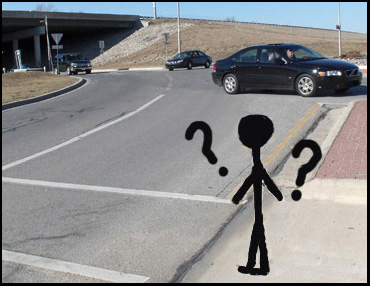
Situations of Uncertainty are situations at crossings with no stop sign or traffic signal where:
you cannot hear / see the traffic well enough to know whether something is coming that could reach you during your crossing,
even when conditions are ideal for that situation.
The complete name for these is "Situations of Uncertainty for gap judgment."
All people can find themselves in Situations of Uncertainty when crossing these streets, whether they use vision or hearing, and whether they are walking or driving across the street.
Examples of what happens at Situations of Uncertainty are:
- pedestrians using hearing are unable to hear approaching traffic with enough warning.
That means when it gets as quiet as possible for that situation, they may know that there is a gap in traffic but they don't know if that gap will be long enough to allow them time to cross.
- pedestrians and drivers using vision, because of something blocking their view, or something like fog, or glare, or impaired vision, are unable to see far enough to have sufficient warning about the approaching vehicles.
In all of these cases, if they start to cross when they hear or see nothing coming, there could be a car coming just beyond their ability to hear or see it -- a car which would have to slow down to avoid hitting them.
Situations of Confidence -- can we still be confident it is "clear to cross when quiet" in some situations today?
You might say, "Well heck, ALL crossings today are Situations of Uncertainty for people who use hearing, especially with the presence of quiet cars!"
But that is not true, according to our research and my experience.
** Today, even with quiet cars, there are many situations where you CAN hear the traffic well enough that, whenever it's quiet, you can be confident that it's clear to cross.
We call these Situations of Confidence.
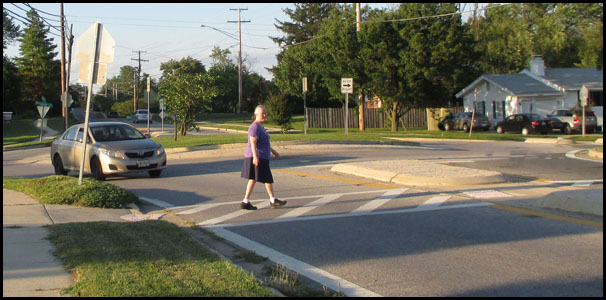
People who use hearing to cross are in Situations of Confidence whenever they can hear all the traffic far enough to know that, if there were any vehicles coming that could reach them during their crossing, they'd be able to hear them.
The same is true, of course, for people who use vision to cross streets -- they are in Situations of Confidence whenever they can see all the traffic far enough to be confident that when they see nothing coming, it is clear to cross.
** Many crossings are Situations of Uncertainty at certain times and Situations of Confidence at other times.
This is true for everyone but it is especially a problem for people who use hearing to cross because, as will be explained later, the characteristics of sound that can change crossings from Situations of Confidence to Uncertainty may not be noticeable.
For example a crossing may temporarily be a Situation of Uncertainty because parked cars are blocking the sound of traffic, or the sound level of "quiet" is high (this will be explained later).
At other times, that same crossing is a Situation of Confidence because the circumstances allow you to hear the approaching traffic well enough (such as when the roads are wet, or it's at night when the sound level of "quiet" is lower).
Whether they use hearing or vision to cross, our students need to be able to recognize and deal with Situations of Uncertainty and Situations of Confidence.
They need to have the life-saving "A" skills for "A"-students, as explained below.
Life-Saving "A" Skills
Our students need the following skills:
ALERT -- be Alert to recognize Situations of Uncertainty;
ANALYZE -- be able to Analyze the level of risk in Situations of Uncertainty;
ALTERNATIVES -- know about Alternatives and be able to use them when the risk of crossing is unacceptable;
ASCERTAIN -- be able to Ascertain crossable gaps in traffic when that is possible (that is, when not in a Situation of Uncertainty).