People with disabilities and their advocates have sometimes requested that special warning signage be posted in areas to help make street crossings safer. Related research has found these signs ineffective but they continue to be installed. The current research examined whether or not posted signage indicating the presence of people who are deaf-blind would cause drivers to yield more frequently for pedestrians with a mobility cane. The results can inform O&M practices and professionals working on behalf of people with disabilities.
- In the United States, orientation and mobility (O&M) specialists are sometimes asked to make recommendations about or support requests to make streets safer by installing signs such as BLIND CHILD AREA or SLOW-DEAF CHILD. The effectiveness of similar signs, such as ‘Children at Play,’ has been shown to be questionable, and studies indicate no reduction in speed or incidence of accidents where they have been installed (Vanderbilt, 2008). Other data cast doubt on the ability of signage alone to control drivers’ behaviours. According to Vanderbilt (2008) in his book, Traffic: Why we drive the way we do, when "drivers routinely see signs warning of deer crossings (in the United States) or elephant crossings (in Sri Lanka) or camel signs (in Tunisia) . . . studies have shown that most drivers do not change their speed at all” (p. 186).
The Manual on Uniform Traffic Control Devices (MUTCD), the American road managers’ professional and technical master guide, suggests that as the number of these signs increases, the effectiveness of each sign is reduced, and a 1993 NCHRP Synthesis of Highway Practice No. 186: Supplemental Advance Warning Devices indicated that these signs are "not considered effective” (Bourquin, 2011). For example, the Kansas DOT (2011) seems unambiguous in their opinion of child area warning signs and lists six rationales against the installations at its website:
- These signs do not describe where the child might be; most streets within a residential area have children who react in the same way, and each driver must be aware of all children in a neighborhood environment; these signs provide parents and children with a false sense of security that their children are safe when playing in or near the street; when the novelty of such a sign wears off, the signs no longer attract the attention of regular passersby; unique or unusual warning signs are a target for vandals and souvenir hunters and have a high replacement cost; unique message signs have no legal meaning or established precedent for use in basic traffic engineering references; their use is discouraged because of both the lack of proven effectiveness and undesirable liability exposure (para. 1-6).
Figure 1. Signage with
deaf/blind pedestrian plaque.
deaf/blind pedestrian plaque.
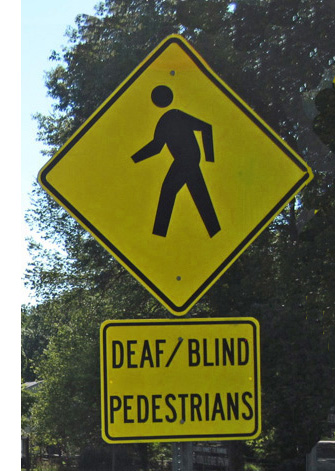 There has not been an empirical study of warning area signage installed for people who are blind, deaf, or deaf-blind. We have only professional opinion and tangential evidence. Specialists who work with people who are deaf-blind have found that some citizens have requested the installation of warning signs. One individual in Maryland who is deaf-blind requested signs be installed (Figure 1) stating that they "help drivers to be aware that deaf-blind people live in the area. I walk across the street and they will stop for me" (Ann Black, personal communication, January 3, 2011).
We decided to see whether or not these signs had any influence on drivers’ yielding as they approached the crosswalk.
-
Several rectangular signs saying DEAF / BLIND PEDESTRIANS (called plaques by traffic engineers) had been installed on poles at crosswalks along College Avenue in Rockville, Maryland, at the request of an individual who is deaf-blind. That individual said she has not crossed at this specific location for the last several months and had crossed there only occasionally before that. The authors talked with some of the people walking along College Avenue and they said they had never noticed people who were blind in the area. That provided reasonable assurance that this site was suitable for our study because the drivers were not likely to have been influenced by frequent experiences of seeing people with white canes crossing there regularly.
Figure 2. View of a vehicle approach to a crosswalk.
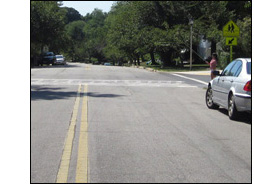
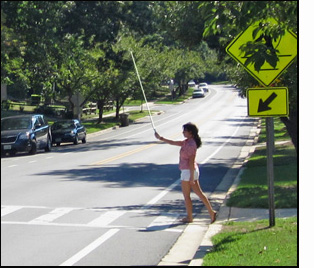 The authors then identified two similar nearby streets (Fordham Ave. and Martin Ave.) which did not have the warning plaques installed. All three crossings had white painted crosswalks with the same traffic control, a diamond-shaped pedestrian crosswalk sign, with either a diagonal arrow or a DEAF / BLIND PEDESTRIANS warning plaque placed on the pole below the crosswalk sign (Figures 1 and 2). The three sites were at streets with similar widths, with one lane for moving traffic in each direction (Figure 3), and each had the same speed limit of 25 mph. According to the Table of Speed and Stopping Distance (James Madison University, 2011), cars travelling 25-30 miles per hour would need 85-109 feet to stop for pedestrians, which we averaged to 97 feet for this study. At each site, landmarks were chosen that were 97 feet to the left and to the right of the crosswalk. The drivers’ line of sight for the pedestrian was at least 97 feet in all trials used to collect data.
In order to determine an effective method for crossing that would be sensitive to drivers' responses the existing literature was reviewed related to yielding at uncontrolled crosswalks and roundabouts. Bourquin, Wall Emerson, and Sauerburger (2011) found that 90% of the drivers yielded for a pedestrian who walked out into the street displaying a cane; in other studies, depending on the type of site, more than 50% of drivers did not yield to pedestrians waiting near the curb with their white cane on the ground (Ashmead, Guth, Wall, Long, & Ponchillia, 2005; Geruschat & Hassan, 2005). To achieve a balance in drivers’ yielding behaviour, a collaborating pedestrian (one of the authors, called the pedestrian from here on) took a single step into the street then stopped and raised the tip of the cane higher than her head and brought it back to the ground several times for each trial.
Figure 3. Crosswalk with
one of the authors crossing.
- We collected data at the three sites using the following procedure:
- 1. The pedestrian wore bright clothes and had a long white cane. She waited approximately 10 feet from the curb until a vehicle approached.
2. The pedestrian walked toward the curb with her cane tapping, reaching the street at about the same time that the driver reached 97 feet from the crosswalk.
3. The pedestrian stepped into the street and, looking straight ahead, she moved the cane high up and down several times and waited for the driver to stop (Figure 2).
4. If the driver stopped, the pedestrian proceeded across. If the driver did not stop, she waited until the car passed and then returned to the sidewalk.
- We presented the pedestrian with the white cane to 27 drivers at College Avenue with the DEAF / BLIND PEDESTRIANS warning plaque (21 from the pedestrian's left and 6 from her right), and 9 drivers at Fordham Avenue and 33 drivers at Martin Avenue, both crosswalks having the diagonal arrow plaques (27 drivers at both crosswalks were from the pedestrian's left, 15 from her right).
We identified two results, yield and no yield, in each of the two conditions, DEAF / BLIND PEDESTRIANS warning plaque (DB plaque) and no DEAF / BLIND PEDESTRIANS warning plaque (No DB plaque). Data indicating yielding (stopping and sufficiently slowing vehicles) were combined. Data from the two sites without DEAF / BLIND PEDESTRIANS warning plaque were combined. Finally, the data was conflated from approaching vehicles in near and far lanes (left and right perpendicular traffic).
Because of the small sample size and results of the ‘no yield’ category data, we used a 2x2 contingency table and computed results from a Fisher’s exact test. The outcome (P value=1.00; 95% CI) indicated no association between the DEAF / BLIND PEDESTRIANS warning plaque and yielding behaviours (Table 1).
Table 1. Yields and no yields at crosswalks.
| Yield | No Yield | Total | |
| No DB plaque | 38 | 4 | 42 |
| DB plaque | 24 | 3 | 27 |
| Total | 62 | 7 | 69 |
- The presence of the DEAF / BLIND PEDESTRIANS plaque appeared to make no difference to drivers. Drivers did not yield more often to a pedestrian with a cane when the warning message was present at the crosswalk than they did when there was no such warning message.
Our results are in accord with studies of the effectiveness of area warning signs and may guide us when making recommendations for such signs for pedestrians who are blind or deaf-blind. Perhaps the false sense of security that warning signage provides to pedestrians is the most crucial factor to consider. Even if drivers are able to notice, read, and process the information, the results are not what a person who is deaf-blind might anticipate. When pedestrians who are deaf-blind and O&M specialists discuss and assess the risks for crossing streets, these study results should be considered.
When and if we are approached to advocate for a DEAF / BLIND PEDESTRIANS or similar warning signage, we can respond with the facts: traffic professionals do not generally recommend these signs and there is no evidence that supports that a sign will make a pedestrian safer, even if the drivers have a good view of the sign and the pedestrian. We can also anticipate that pedestrians, advocates, and others may remain unconvinced, at least when children and people with disabilities are involved. As one transportation department claimed, “Widespread public faith in traffic signs to provide protection and parental concern for children’s safety results in frequent requests for this type of signage” (Shawnee, 2011, para. 2). The best approach may be education for consumers, families, agencies, and schools.
- The number of trials in this study was relatively small. We tested a particular (but standard and common) type and size of warning plaque. Only three sites were used for the trials. These factors may limit the scope for generalising the results. In addition, the likelihood of yielding immediately after the signage was installed is unknown, and, if there was any effect, how long it would have influenced drivers. All vehicles appeared to move toward the crossing at or near the speed limit, but the precise speeds of each vehicle’s approach was also unknown.
The study was conducted on a bright, sunny day with the pedestrian wearing brightly-coloured clothes. It is unknown whether or not the drivers would have responded similarly if it had been raining or dark. We suggest that further research would be useful to find out how pedestrians who are blind or deaf-blind can increase the likelihood that drivers will see them and react appropriately.
- Ashmead, D. H., Guth, D., Wall, R. S., Long, R. G., & Ponchillia, P. E. (2005). Street crossing by sighted and blind pedestrians at a modern roundabout. Journal of Transportation Engineering, 131(11), 812-821.
- Bourquin, E. (2011). Are area warning signs effective? AER O&M Division Newsletter, Summer, 17(3), 2.
- Bourquin, E., Wall Emerson, R., & Sauerburger, D. (2011). Conditions that influence drivers’ yielding behavior while crossing at uncontrolled crossings. Journal of Visual Impairment & Blindness, 105(12), 760-769.
- Geruschat, D., & Hassan, S. (2005). Driver behavior in yielding to sighted and blind pedestrians at roundabouts. Journal of Visual Impairment & Blindness, 99(5), 286-302.
- James Madison University. (2011). Tables of speed and stopping distances. Retrieved from http://www.jmu.edu/ safetyplan/vehicle/generaldriver/stoppingdistance.shtml
- Kansas DOT. (2011). Why signs are not installed. Retrieved from http://www.wichita.gov/NR/rdonlyres/1D3233A9-9AAD-4F4B-850F-520D430C37D9/0/BrochureChildrenatPlaySigns.pdf
- n.a. (2011). FAQ: Traffic. Retrieved from http://gsh.cityofshawnee.org/WEB/ShawneeCMS.nsf/b62f116aa62dde94862575680053ac82/fbd53e28788b62708625759100490ac7?OpenDocument
- Vanderbilt, T. (2008). Traffic: Why we drive the way we do (and what it says about us). New York, NY: Alfred A. Knopf.
Dona Sauerburger MA., COMS., Freelance O&M Specialist, Maryland, USA; e-mail: <dona@sauerburger.org. Eugene Bourquin, DHA., COMS., CI. & CT., CLVT., Helen Keller National Center for Deaf-Blind Youths and Adults, New York, USA: E-mail <OandMHK@msn.com>. Jomania Sauerburger, research assistant, Maryland, USA